Overview: recovery is not one finish date
Hair transplant recovery includes several processes. Recipient and donor wounds heal. Swelling and crusting change. Transplanted shafts may shed. Follicles may later produce new hair. Native hair can continue to change. The cosmetic appearance gradually matures. Feeling ready for desk work does not mean the scalp has completed healing. Visible crust removal does not mean the final result can be judged. The main hair-transplant planning guide gives the broader context for candidacy, risks and travel.
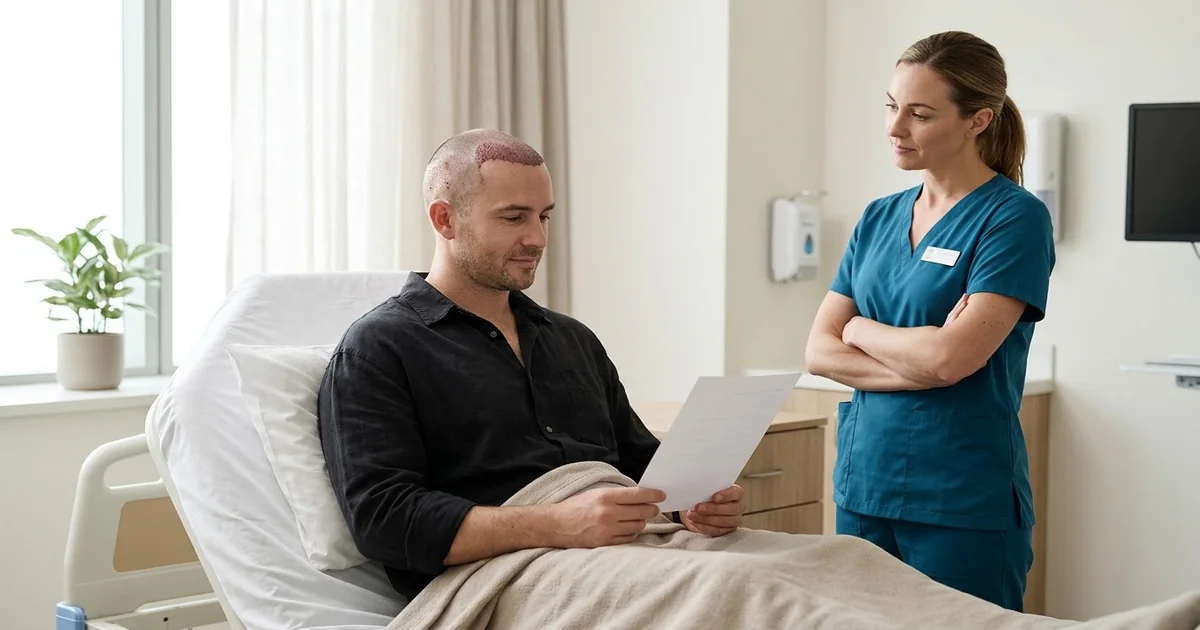
A short guide to preparing for treatment, planning your stay and arranging follow-up.
The stages below are planning ranges, not personal instructions. FUE or FUT harvesting, graft number and distribution, scalp disease, skin response, health, medicine, smoking or nicotine, aftercare, complications, hair cycle and provider protocol can move milestones earlier or later. Follow the treating team's written schedule for washing, products, medication, activity, headwear, travel and review. The candidacy guide explains why recovery planning depends on the diagnosis and proposed scope.
OTEMED coordinates provider information and travel logistics. It does not determine whether a symptom is normal, prescribe treatment, clear a patient to fly or set a recovery or growth date. The independent provider and named clinicians retain clinical responsibility; urgent symptoms may need local emergency care.
Recovery has clinical, social and cosmetic dimensions
Clinical recovery concerns wounds, infection, bleeding, swelling, pain, sensation, scalp disease and medication. Social recovery concerns when a patient feels comfortable returning to work, appearing on camera or attending an event. Cosmetic recovery concerns shedding, regrowth, texture, direction, density and donor appearance. These timelines overlap but are not interchangeable.
A patient may be medically well enough to travel while redness remains visible, or may look socially presentable while a clinical issue needs review. Plan each dimension separately and avoid a clinic that offers one fixed date for every patient and activity.
| Approximate phase | Common focus | Important limitation |
|---|---|---|
| Procedure day | Discharge record, medicines, graft and donor protection | The actual procedure may differ from the preliminary plan |
| First few days | Swelling, sleep, wound care, early review and travel | A package departure date is not medical clearance |
| Early healing | Washing, crust management, redness, itching and work | Protocols and visible recovery vary |
| Early weeks | Activity and product restrictions, possible shedding | Appearance cannot predict final growth |
| Following months | Early regrowth, texture and native-hair monitoring | Progress is often uneven and case-specific |
| Later maturation | Calibre, length, styling, coverage and donor-recipient balance | “Final” timing differs by area and individual |
Procedure day: establish the recovery baseline
Before discharge, ask what was performed, which zones were treated, whether the design or graft plan changed, who was clinically responsible, which medicines were administered or supplied, and whether any event changes follow-up. The procedure record should be clear enough for another clinician to understand.
Review recipient and donor care, sleeping, washing, dressings, medication, food and hydration, activity, warning signs, emergency contacts, the first review and travel. If sedation was used, escort and discharge restrictions may apply. Do not rely on a salesperson's summary when the written clinical plan is unclear.
The first night: protection and observation
The early priorities are avoiding rubbing or direct pressure, following the instructed sleep position, taking only reconciled medicines as directed, and monitoring symptoms. Prepare clean bedding and remove common hazards such as low doorways, overhead cabinets, tight clothing, sleep masks, pets and children who may touch the scalp. The risks and safety guide explains which symptoms need prompt clinical attention.
Some spotting, tightness or discomfort may be discussed as expected for a particular procedure, but persistent bleeding, severe or increasing pain, faintness, breathing difficulty, marked swelling or rapid deterioration needs clinical advice or urgent assessment. A generic recovery chart cannot triage an individual.
The first few days: swelling and early wound care
Swelling can vary in timing and degree. The team should explain how the pattern is expected to behave and whether the forehead, eyelids or other areas may be affected. Do not apply pressure, ice, heat, creams or home remedies to treated areas unless the clinician has specified the exact method and location.
Donor care differs between FUE extraction sites and an FUT incision. Confirm dressings, cleaning, sleeping, pain management and any suture or staple plan. Increasing tenderness, spreading redness, wound separation, discharge, strong odor or progressive donor patchiness should be reviewed rather than normalized from online images.
The first wash and early washing phase
There is no universal first-wash day or method. The provider should specify when to begin, which products to use, application time, water temperature and pressure, rinsing, drying and whether donor and recipient instructions differ. If offered, observe an approved demonstration and obtain written steps in a language you understand.
Do not use fingernails, forceful jets, vigorous massage, high heat or an unapproved towel method. Do not pick crusts to reach a social deadline. If washing causes bleeding, pain or uncertainty, stop improvising and request clinical guidance.
Crusting, redness, itching and tightness
Small crusts, redness, itching and tightness can appear during early healing, but degree and duration vary with the procedure, skin and aftercare. The important question is not whether another patient looked similar, but whether the change fits the expected course described for this patient and whether it is improving.
Do not scratch, squeeze bumps or apply topical antibiotics, steroid creams, acne products, antiseptics, oils or herbal preparations without instruction. Persistent, extensive, painful or worsening changes may require examination rather than remote reassurance.
Around the end of early visible healing
Many patients focus on when crusts are gone or the scalp looks presentable, but visible healing does not mean every restriction ends. Product use, clippers, helmets, swimming, intense exercise and sun exposure may still need separate approval. Recipient and donor areas may progress at different rates. The aftercare guide turns recovery stages into washing, exercise and warning-sign questions.
Redness may remain more or less visible depending on skin, procedure and lighting. Plan work, video calls and events with flexibility. Concealer, fibres, dye or styling products should not be used merely to meet a calendar deadline unless the treating clinician approves the product and application.
The shedding phase
Transplanted hair shafts can shed after surgery while follicles remain beneath the skin. Nearby native hair may also temporarily change. Shedding may be uneven and can be emotionally difficult after an initially denser appearance. It does not by itself prove success or failure.
The treating clinician should review sudden extensive loss, painful or inflamed areas, scarring, progressive donor changes or any course that differs from the written expectations. Do not begin a new medicine or supplement solely because shedding appears online to be ahead of schedule.
The quiet interval before visible regrowth
After shedding, there may be a period with limited visible change. Patients can misinterpret this as failure, especially when marketing calendars promise uniform monthly percentages. Hair follicles cycle independently, and timing can differ across the hairline, mid-scalp, crown, scars, beard or eyebrows.
Use agreed follow-up checkpoints rather than daily comparison. Frequent close-up photography, different lighting and different hair lengths can make normal variation look dramatic. Contact the provider for symptoms or an unexpected course, but avoid using one image to demand early revision.
Early regrowth
When growth becomes visible, hairs can initially appear fine, short, uneven or different in texture. Some zones may seem ahead of others. Early growth should be documented, but it should not be equated with mature calibre, length, coverage or style.
The reviewer should consider donor and recipient health, symptoms, native-hair change, grooming and image conditions—not just count visible hairs. If growth is concerning, the next step may be history, examination, trichoscopy or observation rather than an immediate promise of correction.
Intermediate thickening and styling The quote checklist helps you check whether reviews and follow-up are included.
Over subsequent months, some growing hairs may lengthen and change in calibre or texture, allowing a more useful assessment of direction and coverage. The crown can appear different from the frontal area because of geometry, lighting and growth pattern. Scar and facial-hair cases can follow different cosmetic courses.
A haircut or styling can improve appearance without proving biological change. Keep image conditions comparable and record hair length, product use and haircut date. Ask the clinician when dye, clippers, heat and chemical treatments are appropriate for the treated skin.
Later maturation and result assessment
Later assessment should consider the original diagnosis and plan, donor appearance, hairline naturalness, direction, coverage, calibre, texture, scars, scalp health, progression of native hair and patient priorities. “Final result” is not a single universal month, and continued hair length can change appearance after follicular growth has stabilized.
If the patient is dissatisfied, obtain the operative record and standardized photographs, allow the clinically appropriate maturation period, and clarify whether the issue is growth, design, direction, density, donor depletion, scarring, ongoing loss or expectations. Each problem has different options and constraints.
Returning to work
Work readiness depends on health, visible recovery, job duties, hygiene, heat, dust, bending, lifting, helmets, respirators, physical contact, public presentation and access to breaks. Desk work and remote work differ from healthcare, kitchens, construction, factories, agriculture, military service and sport.
Ask about actual duties rather than one return date. Plan leave with flexibility for swelling, visible redness, travel disruption or clinical review. If required equipment contacts the scalp, bring its fit and use into the pre-procedure discussion.
Exercise, sport and swimming
Walking, running, weight training, bending, yoga inversions, cycling, helmets, contact sport, sauna, steam and swimming have different friction, pressure, sweating, contamination and bleeding considerations. They should not all restart together by default.
Follow the provider's staged advice. If an athlete or worker cannot avoid a required activity, the procedure date or plan may need to change. Do not exercise or deliberately sweat to accelerate recovery.
Sun, weather and headwear
The clinician should explain direct-sun avoidance, when approved headwear can be used and when sunscreen may be applied to healed areas. Tight, abrasive or dirty headwear can create pressure or friction. Heat, sweat, cold, rain and dry air can alter comfort and routine, but no season sets easier healing.
Patients returning to outdoor work or intense climates should plan protection in advance. A cap supplied in a package is not automatic approval for every fit, activity and stage.
Haircuts, colour and ongoing hair-loss treatment
Recipient and donor zones can have different schedules for scissors, clippers, razors, hair dryers, fibres, concealers, gels, sprays, oils, medicated shampoos, dye, bleach and other chemical treatments. Ask about the exact product and application method rather than assuming all grooming is equivalent.
Starting or restarting minoxidil, finasteride or another hair-loss treatment is an individualized clinical decision. Discuss contraindications, adverse effects, monitoring, reproductive context where relevant and who manages treatment after travel. A surgical timeline should include the future of native hair.
Flying home from Istanbul
There is no universal flight day. The clinician should consider symptoms, healing, medication, procedure and journey, while the airline may have separate rules. Long flights also add immobility, fatigue, dehydration, time-zone change, overhead-bag handling and reduced access to the treating team.
Patients with clotting history, significant illness, mobility limits, pregnancy or other relevant factors need individualized advice. Keep records and medicines in hand luggage subject to airline and border rules, know the local emergency route at the destination, and change travel when clinical review requires it.
Warning signs do not belong on a cosmetic timeline
Increasing or severe pain, spreading redness, fever, pus or strong odor, persistent bleeding, marked or rapidly progressing swelling, wound separation, breathing difficulty, chest pain, fainting, confusion, severe allergic symptoms, visual symptoms or rapid deterioration require prompt assessment. This list is not exhaustive.
If symptoms are severe, worsening or the overseas team cannot be reached, use local emergency services or an appropriate nearby facility. A coordinator, automated message or online image comparison is not emergency medical care.
Remote follow-up milestones
A follow-up plan should identify the clinician reviewing progress, communication method, expected response times, out-of-hours coverage, photo checkpoints and reasons for local examination. Ask how complications, medication questions, ongoing hair loss and result concerns are handled after the patient returns home.
Promises of lifetime support or free correction need written scope, exclusions and responsible parties. Follow-up access does not set a revision is suitable, that the original clinician remains available or that travel and local-care costs are covered.
How to take comparable recovery photographs
- Use the same camera, room, neutral lighting, distance, angle and dry-hair condition.
- Capture frontal, top, crown, profiles and relevant donor views.
- Keep original, unedited files; avoid filters, collages, screenshots and beauty modes.
- Record the date, symptoms, hair length, haircut, styling products and medicine changes.
- Do not use fibres, concealer, wet hair or styling that changes scalp visibility.
Standardized images reduce false differences caused by light, hair length and styling. They support remote review but do not replace examination, tests or urgent care when needed.
When a recovery concern becomes a result concern
Early swelling, crusting or shedding is different from later concerns about growth, design, direction or density. The provider should explain when the type of question changes and what evidence is needed. It is rarely useful to label an early appearance as a final result.
If an expected milestone is not met, review the original plan, diagnosis, procedure record, donor and recipient photographs, symptoms, treatment and native-hair progression. The appropriate response may be observation, medical evaluation, treatment of a scalp condition, camouflage, styling or later repair assessment—not automatically another transplant.
Revision has its own timeline
Revision should wait until sufficient maturation for the specific issue and requires reassessment of diagnosis, scalp health, scars, design, direction, remaining donor capacity and realistic goals. Additional harvesting can worsen donor depletion, and a correction can be more complex than the first procedure.
Obtain records and consider an independent opinion. A free-revision promise cannot set suitability, growth, clinician availability or coverage of flights, accommodation, local care and time away from work.
Recovery-timeline red flags
- The same washing, flight, work, exercise and growth dates are setd for everyone.
- A fixed percentage of graft growth or density is promised by a specific month.
- Persistent or worsening symptoms are dismissed as normal without clinician review.
- Medication changes are directed by sales or coordination staff.
- Crust removal, products or vigorous care are promoted to meet a cosmetic deadline.
- There is no named remote reviewer, response time, out-of-hours route or local-care plan.
- The patient is pushed toward early revision before diagnosis and maturation are reassessed.
Build an individualized recovery plan
Document the baseline
Obtain the procedure record, treated zones, medicines, responsible clinician and relevant changes.
Follow early wound care
Use the written recipient, donor, washing, sleep and medication protocol for the actual procedure.
Separate activity milestones
Confirm work, exercise, sport, swimming, sun, headwear, grooming and travel independently.
Monitor without overinterpreting
Recognize shedding and uneven early growth while escalating symptoms and unexpected change.
Document consistently
Take matched, unedited donor and recipient photographs and record relevant context.
Assess mature outcomes
Review growth, design, direction, coverage, donor balance, scalp health and native-hair progression.
Bottom line
Hair transplant recovery moves through overlapping clinical, social and cosmetic phases. Use approximate stages to plan questions, not to set a flight, work date, shedding pattern or result. Follow the named clinician's written protocol, escalate worsening symptoms, document progress consistently and wait for stage-appropriate assessment before considering correction.
